 Call us now:
New VAT Threshold in South Africa: Can You Deregister for VAT if Your Turnover Is Below R2.3 Million?
Recent changes to VAT legislation in South Africa have increased the VAT registration threshold, leaving many business owners asking an important question:
If my business earns less than R2.3 million per year, can I deregister for VAT?
While the new threshold creates more flexibility for small and medium businesses, deregistering for VAT is not always straightforward. There are rules, processes, and potential financial implications that business owners should fully understand before making this decision.
In this article, we explain what the new VAT legislation means, how SARS handles VAT deregistration, and the steps you need to follow if you want to deregister your business.
What Is the New VAT Threshold in South Africa?
Previously, businesses were required to register for VAT if their taxable turnover exceeded R1,000,000 in any consecutive 12-month period.
Under the new legislation, the mandatory VAT registration threshold has been increased to R2,300,000 per year.
This means that businesses generating less than R2.3 million in taxable turnover over a 12-month period are no longer required to remain VAT registered.
However, this change does not automatically cancel existing VAT registrations. Businesses must still apply to SARS if they wish to deregister.
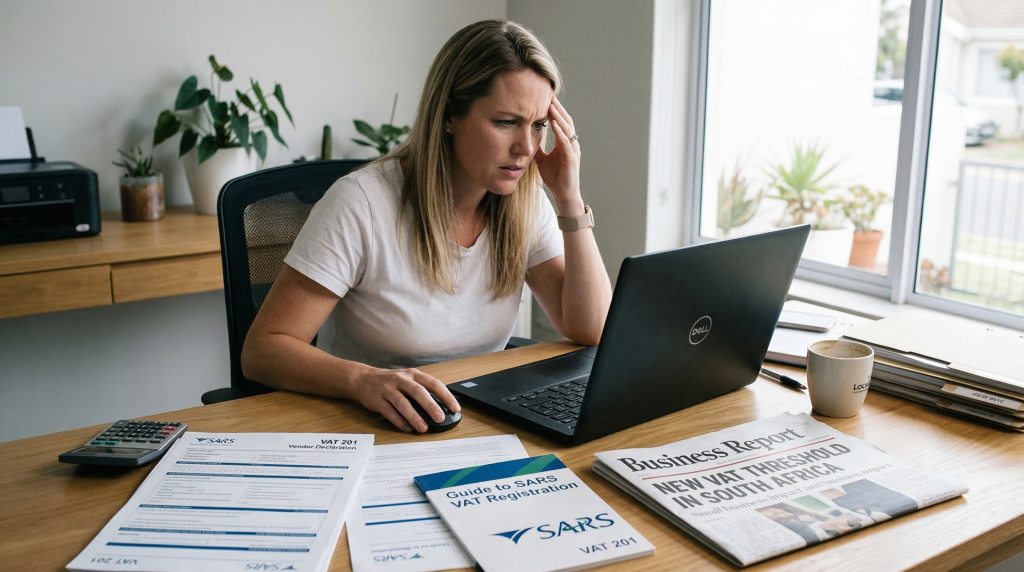
Can You Deregister for VAT if Your Turnover Is Below R2.3 Million?
Yes. If your business turnover falls below R2.3 million in any 12-month period, you may apply to SARS to deregister for VAT.
However, SARS will only approve the deregistration once certain requirements are met.
These include:
- Confirming your turnover is below the new threshold
- Submitting a VAT deregistration request
- Declaring VAT on certain business assets and inventory
- Submitting your final VAT return
Because of these requirements, many business owners are surprised to learn that deregistering may trigger a once-off VAT payment to SARS.
Step-by-Step Guide: How to Deregister for VAT with SARS
If you are considering VAT deregistration in South Africa, the process usually follows these steps.
Step 1: Confirm Your Annual Turnover
The first step is confirming that your taxable turnover is below R2.3 million within a 12-month period.
SARS may request financial records such as:
- Income statements
- Sales reports
- Accounting records
Accurate bookkeeping is essential when applying for VAT deregistration.
Step 2: Evaluate Whether Deregistration Is Beneficial
Even if you qualify to deregister, it may not always be the best financial decision.
Remaining VAT registered may benefit businesses that:
- Buy large amounts of stock or equipment
- Claim significant input VAT
- Supply other VAT-registered businesses
Deregistering may affect:
- Your pricing structure
- Your ability to claim VAT on purchases
- Your business competitiveness
A professional tax advisor can help determine whether deregistration is advantageous.
Step 3: Submit a VAT Deregistration Request to SARS
If you decide to proceed, you must submit a VAT deregistration application to SARS.
This can be done through:
- SARS eFiling
- A registered tax practitioner
- A SARS branch appointment
SARS will then review the request and may request supporting documentation before approving the deregistration.
Why SARS Requires VAT on Assets and Inventory
One of the most important rules when deregistering for VAT is the requirement to declare VAT on certain business assets and stock.
This is because you may previously have claimed input VAT when purchasing those items.
When you deregister, SARS treats the situation as if the business has disposed of those assets.
How VAT Is Calculated on Business Assets When Deregistering
When applying for VAT deregistration, you must calculate VAT on the open market value of certain business assets and trading stock.
Examples include:
- Trading stock
- Equipment and machinery
- Office furniture
- Business vehicles
- Other assets where input VAT was claimed
The VAT payable is calculated as:
15% of the current market value of those items.
Example:
If your business holds inventory worth R100,000, the VAT payable could be:
R100,000 × 15% = R15,000 VAT payable to SARS
This amount must be declared in your final VAT return before deregistration is approved.
What Happens After You Apply to SARS?
Once the application has been submitted:
- SARS reviews the VAT deregistration request.
- SARS may request additional documentation.
- Your final VAT return must be submitted.
- VAT on assets and inventory must be declared.
- SARS confirms the deregistration date.
Only after these steps are completed will your VAT registration be officially cancelled.
How Long Does VAT Deregistration Take?
The timeline varies depending on the complexity of the business and SARS processing times.
In most cases, the process can take several weeks from the time the application is submitted.
Ensuring your financial records and asset valuations are accurate can help avoid delays.
Advantages of Deregistering for VAT
For some businesses, VAT deregistration can offer several benefits:
- Reduced administrative workload
- No VAT returns to submit
- Simplified accounting
- Potentially lower pricing for non-VAT registered customers
Possible Risks of VAT Deregistration
However, there are also potential disadvantages.
These include:
- Losing the ability to claim input VAT on expenses
- Paying VAT on existing assets and inventory
- Impact on pricing and profit margins
- Potential credibility concerns with VAT-registered clients
For these reasons, deregistration should always be evaluated carefully.
Advice from a Tax Expert
The new VAT threshold gives many South African businesses the option to deregister for VAT. However, the decision should be made carefully, considering both the financial and operational implications.
A qualified tax professional can assist you by:
- Evaluating whether deregistration is beneficial
- Calculating VAT payable on business assets
- Managing the SARS deregistration process
- Ensuring full compliance with VAT legislation
If you are unsure whether deregistering for VAT is the right decision for your business, professional advice can help you avoid costly mistakes.
Visit www.consyltaxes.co.za and submit your tax question today.
The Consyl Taxes team will gladly help you navigate the latest VAT changes with confidence.